
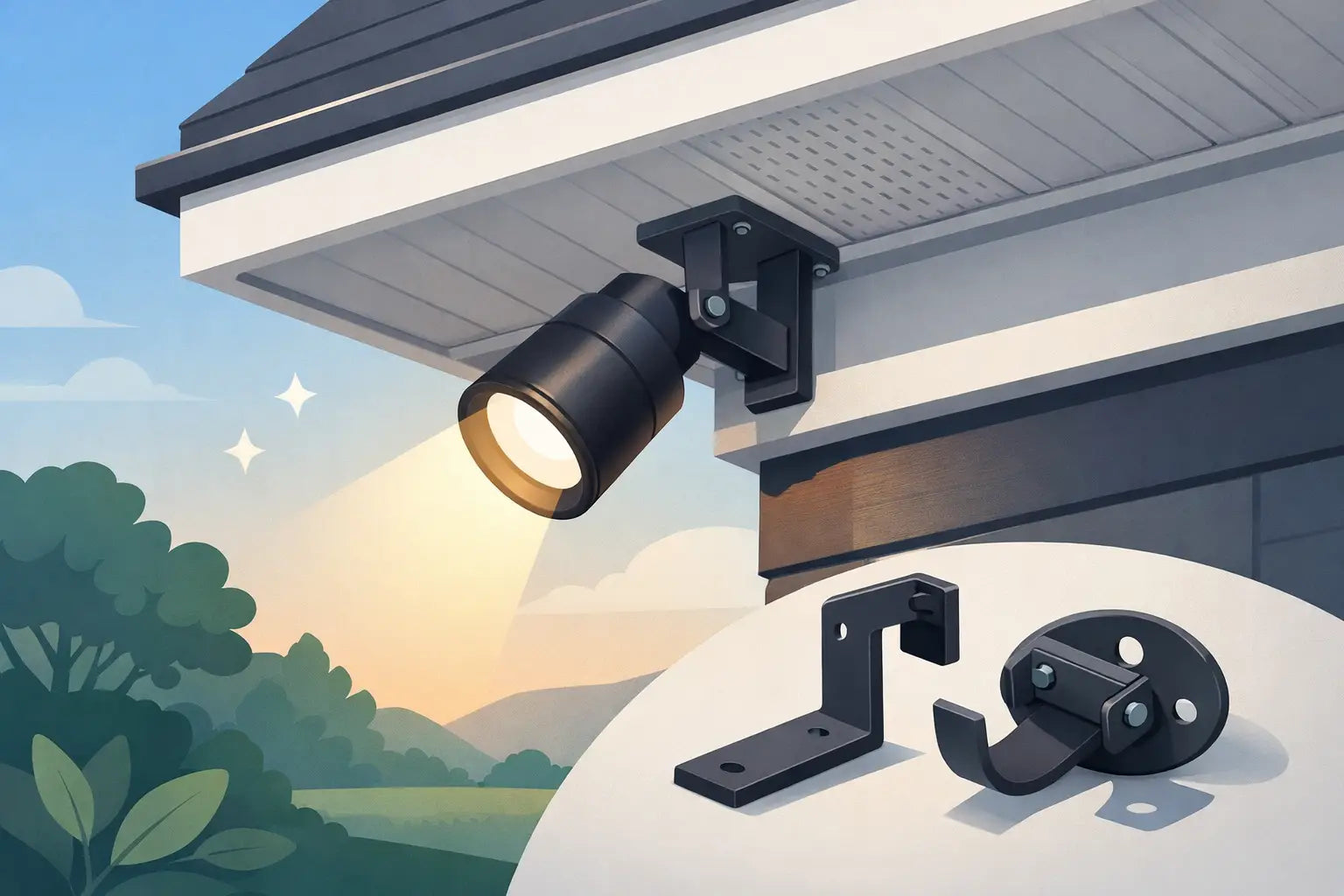
If you have ever tried installing permanent lights under an eave with the factory clips that came in the box, you already know where the job starts to go sideways. Outdoor soffit light brackets are supposed to make the install cleaner and more secure, but the wrong bracket can leave lights crooked, loose, or hanging lower than they should. That is not just a cosmetic issue. It affects beam direction, long-term hold, and how confident you feel every time wind, heat, or heavy rain moves through.
For most homeowners, the goal is simple. You want your lighting to look straight, stay put, and feel permanent. The challenge is that soffits are not all built the same, and stock hardware is usually designed to be broadly usable, not purpose-built for your exact lighting system, mounting surface, or spacing needs.
That is where bracket choice matters more than people expect.
What outdoor soffit light brackets actually need to do
A good bracket does more than hold a light in place. It needs to position the fixture at the right angle, keep spacing consistent, and resist the small failures that show up over time. Under a soffit, those failures usually come from heat cycling, moisture, vibration, and poor surface contact.
If the bracket does not sit flush, the light can tilt. If the fit is loose, the fixture can shift after installation. If the material is too brittle, it may survive the first install and still fail months later. And if the design forces you to fight the hardware on a ladder, install time goes up while confidence goes down.
That is why outdoor mounting hardware should be judged on performance, not just whether it technically fits.
Why stock clips often fall short under soffits
Factory hardware is usually built for packaging efficiency and basic compatibility. That makes sense from a mass-production standpoint, but it leaves a gap for homeowners trying to create a polished roofline install.
Under soffits, alignment is everything. Even a slight twist in one light becomes obvious when the whole run is visible from the street. Stock clips can also struggle when the mounting surface is not perfectly flat, when the soffit material flexes, or when the light body needs a more stable seat than adhesive alone can provide.
There is also the issue of permanence. Temporary-looking hardware can make an expensive smart lighting system feel like a seasonal add-on instead of a finished exterior upgrade. A better bracket helps the install look intentional.
The best outdoor soffit light brackets are product-specific
This is the part many buyers miss at first. A bracket that is made for a general category of outdoor lights is not the same as one designed around a specific light body, wire path, and mounting orientation.
Product-specific brackets tend to install faster because the fit is already worked out. You are not improvising with extra tape, shims, or awkward screw placement. The light seats where it should, and the bracket supports the fixture the way it was intended to be displayed.
That matters even more with smart exterior systems like Govee permanent lights, where spacing, angle, and visual consistency directly affect the final result. A purpose-built mount usually gives you cleaner projection and a more uniform appearance across peaks, gables, straight runs, and transitions.
For homeowners who want a finished look without trial and error, that difference is worth paying attention to.
Material quality matters more outdoors than it does in the garage
A bracket can look fine in your hand and still be the wrong choice for an exterior installation. Outdoor conditions are hard on small parts. Sun exposure, summer heat, freezing temperatures, and repeated expansion and contraction all test the material.
That is why weather resistance should not be treated like a nice extra. It is the baseline. A well-made outdoor bracket needs to keep its shape, maintain its hold, and avoid cracking or warping when conditions change.
This is one reason 3D-printed mounting accessories have earned real attention when they are engineered correctly. The key is not just that they are printed. It is that they can be designed around exact dimensions and produced in materials selected for exterior use. When done right, that gives homeowners a better fit and a more dependable install than generic hardware designed to cover too many use cases at once.
Fit and alignment are what make the install look professional
When people say they want a cleaner install, they are usually talking about three things at once. They want the lights to sit consistently, the wiring to stay controlled, and the final line to look straight from every viewing angle.
Outdoor soffit light brackets play a big role in all three. The bracket controls how the light sits under the eave. It influences whether the fixture points where it should. And it helps reduce the uneven spacing and sagging that make a permanent system look patched together.
This is especially noticeable on longer rooflines. One or two misaligned fixtures may not seem like much during installation, but they stand out fast when the system is on at night. A bracket with a secure, repeatable fit helps prevent that problem before it starts.
Installation ease is not a small detail
Most soffit lighting installs happen on a ladder, often overhead, often while you are managing lights, hardware, tools, and wire at the same time. That is not the place for hardware that needs constant adjustment or extra force to work.
A well-designed bracket should reduce friction in the process. It should be easy to position, easy to fasten, and easy to repeat across the full run. If it saves you a minute per light, that adds up quickly. More importantly, it reduces the chance of mistakes when fatigue sets in.
This is where practical design beats flashy claims. Homeowners do not need hardware that sounds impressive in a product description. They need hardware that works reliably when they are halfway through an install and want the next section to go as smoothly as the first.
Not every soffit setup needs the same bracket style
There is no single best bracket for every home. The right choice depends on the light model, soffit material, roofline shape, and whether you are installing on a straight run or working around architectural details.
Some homeowners need a low-profile mount that keeps the fixture tucked tight under the soffit. Others need a bracket that improves hold on less forgiving surfaces. In some cases, retrofit-friendly designs matter most because the lights are already up and the original hardware is not performing well.
That is why one-size-fits-all solutions tend to disappoint. Exterior lighting is visible. Small fit issues become visible issues. A better approach is to choose hardware based on the actual install conditions, not just the product label.
When a custom mount is the smarter buy
If you are investing in permanent smart lighting, it makes sense to protect the look and performance of that system with mounting hardware that matches the job. A custom or model-specific mount is usually the smarter buy when you care about durability, cleaner alignment, and less installation frustration.
It is also the better option when you have already learned the hard way that stock clips are not enough. Many homeowners upgrade only after a partial failure, a sloppy appearance, or an install that took far longer than expected. At that point, the value of purpose-built hardware becomes very obvious.
Brands like PrintWorks 3D focus on this exact gap. The advantage is not novelty. It is field-relevant design - mounts made for real exterior conditions, specific light systems, and homeowners who want the install done once and done right.
What to look for before you buy
Before choosing outdoor soffit light brackets, pay attention to how the bracket matches your light model, how it mounts to the surface, and what material it is made from. Look closely at whether it supports consistent positioning and whether the design appears stable enough for long runs under exposed exterior conditions.
It also helps to think about your install day, not just the finished photo. Will the bracket be easy to handle overhead? Does it appear to guide the light into place or make you fight for alignment? Is it built for a permanent setup, or does it feel like a workaround?
The best bracket is rarely the cheapest piece of hardware in the project. It is the one that protects the result you actually care about.
A permanent lighting system should look intentional from day one and stay that way through the seasons. If your current hardware leaves too much to chance, better brackets are not an accessory. They are part of the install itself. Choose the option that gives your lights a secure fit, a straight line, and the kind of hold you do not have to think about again.
Share:
Govee Mounting Accessories That Actually Hold
How to Hide Govee Power Supplies Cleanly