

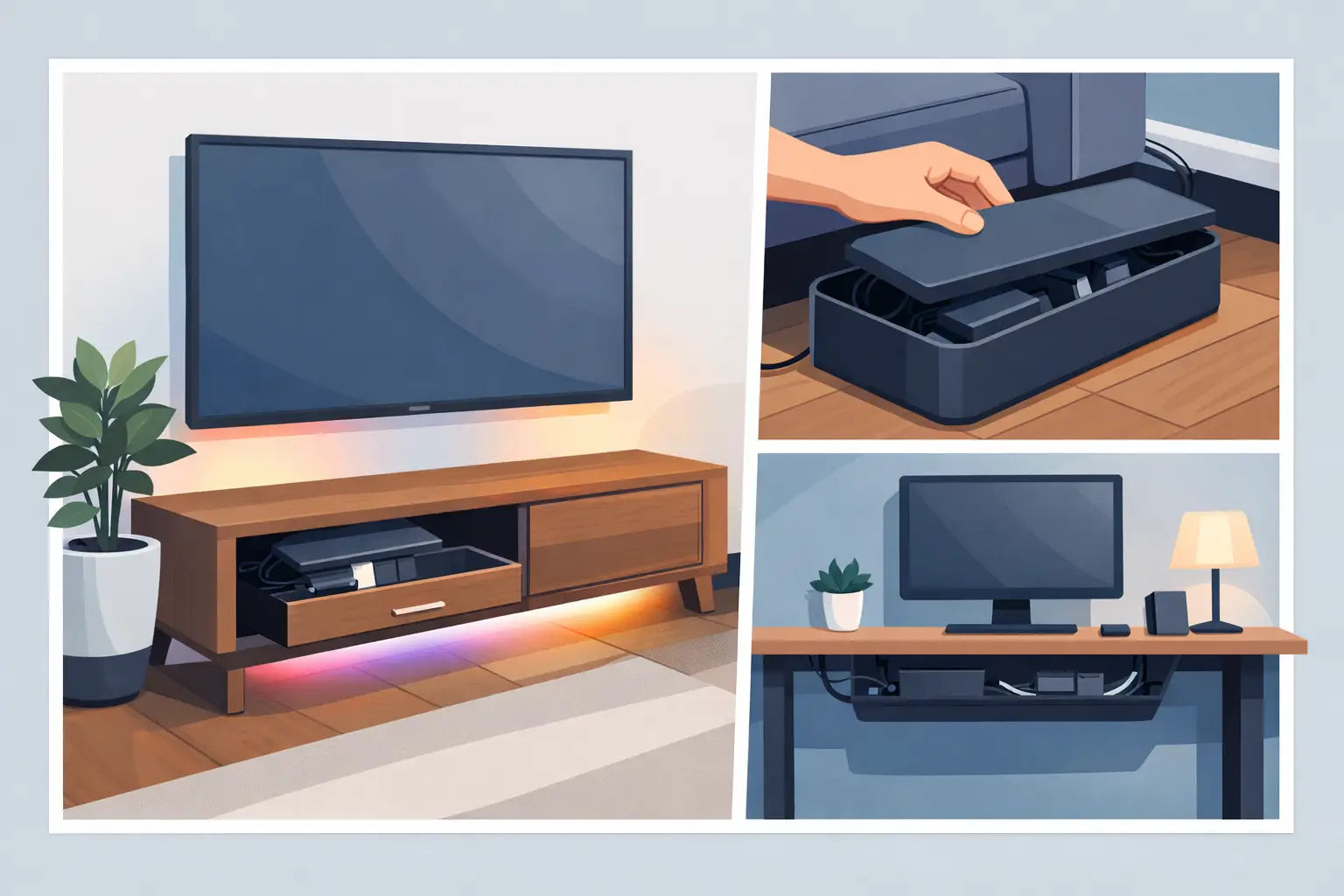
The lights look great at night. The power brick, extra wire, and controller box hanging under the eave do not. If you're figuring out how to hide Govee power supplies, the goal is not just making them less visible. You also want a setup that stays accessible, handles weather, and does not create a maintenance headache six months from now.
That balance matters most on permanent outdoor installs. A hidden power supply that overheats, traps water, or forces you to cut zip ties every time you need to troubleshoot is not really an upgrade. The cleanest installs are the ones that look intentional and still give you a practical path for service.
What makes Govee power supplies hard to hide
Most homeowners run into the same issue. The lights themselves can follow the roofline cleanly, but the power supply and controller are bulkier, less flexible, and usually land near a corner, outlet, or soffit where everything is easy to see.
Govee setups also create a few competing priorities. You need enough clearance for airflow. You need protection from direct rain and sun. You need cable routing that does not sag or pull against the connection points. And if your install is on a front-facing section of the house, even a small amount of visible hardware can stand out more than expected.
This is why hiding the power supply usually works best as part of the mount plan, not as an afterthought. Once the lights are already up, people tend to improvise with tape, loose clips, or a random utility box that does not fit the location very well.
The best places to hide Govee power supplies
If you want the cleanest result, start by choosing the least visible location that still gives you safe access to power. Under the soffit is usually the first choice because it naturally shields components from direct exposure and keeps everything close to the light run.
Behind a fascia return or trim corner can also work well if the power supply fits without being pinched or pressed into a tight cavity. The goal is to break the direct line of sight from the street without stuffing the hardware into a space it was never meant to occupy.
Another solid option is mounting the power supply near the outlet but tucking it up behind architectural features such as a downspout line, beam wrap, porch ceiling edge, or garage trim transition. This approach is often cleaner than trying to push everything right next to the first light. It also reduces visible wire loops if your outlet placement is not ideal.
If the outlet is in a very exposed spot, some homeowners use a weather-rated enclosure nearby and route the low-voltage side out cleanly. That can work, but the box needs proper ventilation and room for cable bends. A cramped enclosure may solve the visual problem while creating heat or moisture issues.
How to hide Govee power supplies without causing problems
The biggest mistake is hiding for appearance only. Permanent lighting components still need to function outdoors, and the install needs to hold up through heat, cold, wind, and seasonal maintenance.
Start with airflow. Power supplies generate heat, and even when they are weather resistant, they are not meant to be wrapped tightly in insulation, plastic bags, or layers of tape. If you are using any cover or enclosure, make sure it protects from direct exposure without sealing the unit into a hot box.
Next is water management. Hiding under a soffit is usually safer than mounting on a fully exposed wall, but you still need to think about wind-driven rain and drip paths. Keep the unit elevated off surfaces where water can collect, and avoid low points where cables create a route for moisture to track toward connections.
Cable strain matters too. If the power supply is hidden but the wire is pulling tight across a corner or hanging with a visible dip, the install still looks unfinished. Secure the cable path first, then place the power supply where the routing feels natural.
Service access is the last piece people overlook. At some point you may need to reset the controller, inspect a connection, or replace a component. If hiding the setup means removing trim or disassembling a box mounted fifteen feet up, it is probably too hidden.
A cleaner install comes down to mounting strategy
This is where a lot of visual clutter gets solved. A properly mounted power supply and controller look cleaner because they stay aligned, close to the structure, and out of the way of the light line.
Ad hoc methods tend to create bulk. Zip ties around random brackets, adhesive pads on dusty soffits, or a shelf made from scrap material may hold for a while, but they rarely look finished and often fail in outdoor conditions. Heat, moisture, and seasonal expansion work against those quick fixes.
A purpose-built mount changes the result because it controls position. The power supply sits where you want it, the controller does not twist or dangle, and cable routing can be planned around fixed points instead of floating components. That matters both for curb appeal and for long-term durability.
For homeowners installing permanent outdoor lights, this is usually the difference between a setup that looks like an add-on and one that looks like it came with the house. PrintWorks 3D focuses on that exact problem with product-specific mounts designed to make Govee installations cleaner, faster, and more secure.
How to hide Govee power supplies on different parts of the house
Front rooflines and entry areas
This is where visual cleanup matters most. Anything mounted near the front door, porch ceiling, or garage peak is easier to spot from the street. In these zones, place the power supply on the least visible return side of the soffit or just above the viewer's normal sightline.
Try to avoid mounting directly in the middle of an open porch ceiling unless there is no better option. Even if the hardware matches the color reasonably well, the shape tends to draw attention. A side transition or corner return usually hides it better.
Garage sections
Garage rooflines often give you more flexibility because outlets are more common and trim depth is usually more forgiving. If the outlet is near the door opening, move the power supply up and back so it does not compete visually with the main face of the garage.
This is also one of the easiest places to overdo cable slack. Keep extra length controlled and tucked along a trim line instead of coiling it into a visible bundle.
Peaks, gables, and second-story runs
For higher sections, the smartest answer is often to keep the power supply lower and route upward cleanly rather than trying to hide everything at the top. A power supply near the base of a difficult roofline is much easier to access and usually easier to conceal near a corner or lower soffit.
If you do mount higher, think ahead about service. A hidden component that requires a ladder every time you want to reach it should be mounted very securely and placed where it can still be accessed without disturbing the light run.
Common hiding methods and their trade-offs
Painting a mount or cover to blend with the house can help, but it only works if the shape is already tucked into a good location. Color match improves discretion. It does not fix bad placement.
Weather-rated boxes can create a tidy look, especially near outlets, but size matters. Too large, and the box becomes more obvious than the power brick. Too small, and cable routing becomes cramped and messy.
Tucking components behind trim can look excellent when the space is naturally protected and open enough for safe clearance. It works poorly when the hardware is forced into a cavity or pressed against sharp edges.
Simple clip-and-route methods are often enough for shorter runs on sheltered sections of the house. But if your setup includes multiple visible transitions, exposed corners, or a prominent front elevation, dedicated mounts usually produce a cleaner finish with less trial and error.
The practical checklist before you mount anything
Before you commit to a location, stand in the street and look at the house from the same angle other people will. Then check the spot for four things: direct visibility, outlet reach, weather exposure, and future access.
If one location wins on looks but loses badly on serviceability, keep looking. The best hidden install is usually not the most concealed possible spot. It is the one that keeps the hardware out of sight enough while still allowing proper mounting and maintenance.
It also helps to mock up the power supply position before final install. Hold it in place, route the cable loosely, and check how the line looks from below. Five minutes of testing can save you from drilling into the wrong section of soffit or ending up with a cable path that feels awkward.
A clean Govee install is not just about the lights being straight. It is about every visible part of the system feeling deliberate. When the power supply, controller, and cable routing are mounted with the same care as the lights themselves, the whole project looks more permanent, more polished, and more worth the effort.
Share:
Outdoor Soffit Light Brackets That Last
Guide to Permanent Light Retrofits