

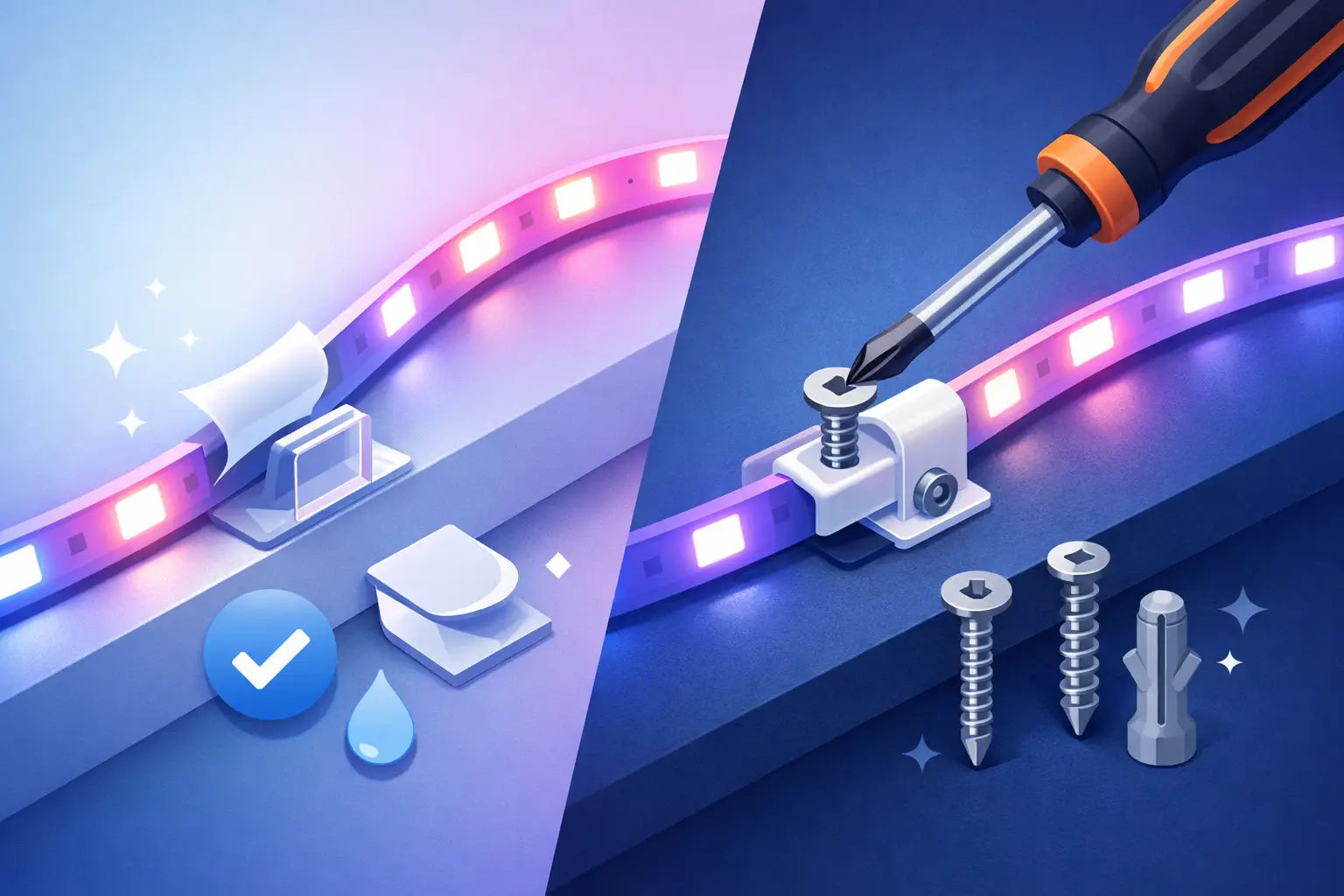
A permanent lighting install can look finished on day one and still fail its first real test: a hot afternoon, a freeze-thaw cycle, or a wind-driven rainstorm. That is why the adhesive clips vs screw mounts decision matters before you start climbing the ladder. Both can hold Govee lights in the right setting, but they do not carry the same long-term risk, installation requirements, or visual payoff.
For homeowners installing permanent outdoor lights along soffits, fascia, peaks, and gables, the goal is usually clear: straight light spacing, secure cable management, and a result that stays put. The best mounting choice depends on your surface, your willingness to make small pilot holes, and whether you want a temporary shortcut or a truly permanent installation.
Adhesive Clips vs Screw Mounts: The Real Difference
Adhesive clips use a pressure-sensitive backing to attach directly to a cleaned surface. They are fast, require no drill, and can be useful when you need to position a wire or light temporarily. Screw mounts fasten mechanically into the mounting surface, creating a physical connection that does not depend on adhesive staying bonded through heat, moisture, dust, and surface movement.
That distinction becomes more important outdoors. Adhesive strength is affected by how well the surface was cleaned, the temperature during installation, paint condition, texture, UV exposure, and humidity. A clip may hold perfectly on smooth, clean metal in mild weather, then gradually release from painted wood or textured vinyl after a season of expansion and contraction.
Screw mounts ask more from the installer upfront. You need to measure, align, and drive fasteners carefully. In return, you get a repeatable attachment point that is far less likely to shift when the cable is pulled, a light is adjusted, or weather puts stress on the run.
When Adhesive Clips Make Sense
Adhesive clips are not automatically the wrong choice. They can be practical for short indoor runs, temporary layouts, or low-stress cable routing where drilling is not an option. They are also useful during planning. You can test placement, confirm light direction, and make sure your spacing looks right before committing to a permanent mounting pattern.
They work best on a smooth, stable, thoroughly cleaned surface. The area should be dry and free of dust, chalking paint, oils, and residue. Installation temperature matters too. Adhesive applied in cold weather may not bond properly, even if the clip feels secure when you first press it into place.
For an outdoor Govee installation, adhesive clips are generally a better fit for a minor support role than as the primary long-term mounting strategy. If a cable needs a little extra guidance around a corner or near a controller, an adhesive clip may help. Relying on adhesive alone to hold an entire outdoor lighting system overhead is a different decision.
There is also the removal question. Adhesive can leave residue, pull loose paint, or separate unpredictably from weathered surfaces. It may feel less permanent because it requires no holes, but it is not always the cleaner option when it eventually needs to come off.
Why Screw Mounts Are Better for Permanent Outdoor Lights
Screw mounts are built for the part of the job that matters most: keeping the lights aligned and supported year after year. A properly installed mount resists the forces that work against outdoor adhesive, including changing temperatures, vibration, cable tension, and water exposure.
The benefit is not just holding power. Mechanical mounts help maintain the intended angle and distance of each light. That consistency is what gives a roofline or gable a polished, intentional appearance after dark. When one puck rotates, sags, or moves away from the surface, the lighting pattern can look uneven even if every other light is working correctly.
Purpose-built screw mounts also make installation more controlled. Instead of improvising with generic clips that may pinch the cable or place the light at the wrong angle, a product-specific mount supports the light body where it needs support. This is especially valuable on peaks, corners, and trim details where stock options can be awkward to use.
For Govee outdoor lights, PrintWorks 3D mounts are designed around those real installation challenges. The goal is a secure fit that helps lights stay straight, look clean, and handle exterior conditions without turning your lighting project into a future repair job.
Better alignment starts with a fixed reference point
A screw-mounted system lets you establish a line and follow it. Once your first few mounts are level and spaced correctly, the rest of the run becomes much easier to repeat. This matters on long soffits, where even small inconsistencies become visible when the lights turn on.
Adhesive clips can shift during installation or release slightly over time. That can change the light direction enough to create hot spots, uneven wall washing, or a wavy visual line. Mechanical mounting gives each light a stable reference point.
Weather resistance is about the whole installation
A weather-resistant light is only as dependable as the hardware holding it in place. Outdoor mounting systems face sun, rain, wind, snow, temperature swings, and seasonal expansion of building materials. Adhesive can degrade gradually, often without an obvious warning until a section starts hanging loose.
Screws do require proper material selection and installation. Use fasteners appropriate for your mounting surface, avoid overdriving them, and do not force a mount onto warped or damaged trim. When installed correctly, screw mounts provide the kind of physical security permanent lighting deserves.
Choosing the Right Mount for Your Surface
Your exterior material should guide the decision. Painted wood soffits and fascia are common locations for permanent lights and usually work well with screw mounts when installed carefully. A small pilot hole can reduce the chance of splitting and make it easier to drive the screw straight.
Vinyl, aluminum, and composite surfaces require more thought. Do not assume every visible panel is thick enough to hold a screw securely. In some cases, you may need to fasten into a backing board, trim structure, or another solid substrate behind the finished surface. Mounting into a weak panel can lead to loose hardware, distorted material, or water-related problems later.
Brick, stucco, and masonry need surface-specific anchors and more planning. If your run crosses several materials, use the mounting method that is appropriate for each section rather than forcing one solution everywhere. The right mount is the one that stays secure without damaging the structure you are trying to improve.
Installation Habits That Prevent Rework
The best hardware still benefits from a careful install. Start by running the lights loosely and confirming where each puck, cable segment, corner, and controller will sit. Check the appearance from the street before drilling. A few minutes of layout work can save an afternoon of moving mounts.
Mark your mounting line with painter's tape or a pencil where appropriate, then install a short test section. Turn the lights on at night and look for uneven spacing, tilted pucks, or areas where the light output is blocked by trim. Adjust early, before the whole run is fastened.
When you are ready to install, avoid pulling cable tight between mounting points. Leave enough natural slack for clean routing and normal material movement, but not so much that cable hangs visibly. Keep connectors accessible where possible and support heavier controller or power components with hardware made for their size and shape.
For a professional-looking result, pay special attention to transitions. Peaks, corners, and changes in roofline height are where generic mounting hardware often shows its limits. A mount designed for the specific Govee light style and installation angle can make those difficult sections easier to finish cleanly.
The Practical Choice for a Lasting Install
If you need a fast, no-drill solution for a temporary or low-stress application, adhesive clips can be useful. Just prepare the surface carefully and treat the bond as a condition that should be checked over time. Outdoors, especially overhead, adhesive is a compromise between convenience and long-term confidence.
If you are installing Govee permanent lights because you want to stop rehanging seasonal lights and enjoy a clean exterior year-round, screw mounts are usually the better choice. They take a little more planning, but they provide the secure attachment, consistent alignment, and weather-ready performance that permanent lighting calls for.
A well-mounted lighting system should disappear into the architecture during the day and deliver the effect you planned at night. Choose hardware that supports both parts of that job, then take the extra time to install it once with confidence.
Share:
7 Best Upgrades for Govee Installs That Last
Can You Remount Permanent LED Lights Safely?