
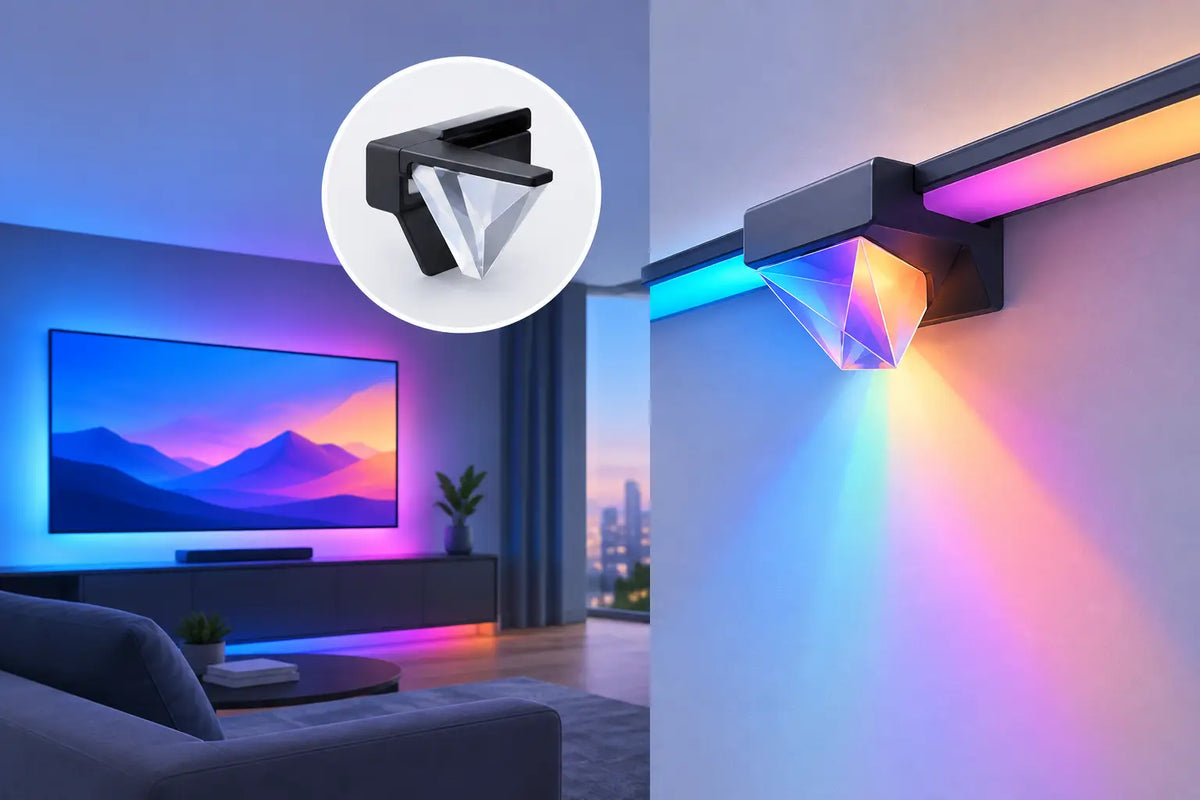
A roofline can look finished or frustrating based on a few small details: light spacing, wire management, and whether every fixture stays where you put it. So, what is a prism light mount? It is a purpose-built mounting accessory designed to hold compatible Govee outdoor light modules in a consistent position, helping create a clean, permanent-looking installation on soffits, fascia, gables, and other exterior surfaces.
For homeowners installing smart permanent lighting, the mount is not an afterthought. It is the piece that helps turn a string of individual lights into a straight, intentional lighting layout that can hold up through seasonal temperature changes, wind, rain, and repeated use.
What Is a Prism Light Mount Designed to Do?
A prism light mount is a fitted bracket that supports a compatible light housing rather than asking adhesive alone to carry the load. The mount creates a defined place for each light to sit, which helps with alignment, spacing, and long-term retention.
The word “prism” generally refers to the style or compatible light configuration the mount is designed around. It does not mean the mount changes the colors or effects produced by your Govee system. Your controller and light modules still handle the smart features. The mount’s job is mechanical: keep the light properly positioned so the lighting pattern looks consistent from the street and stays secure overhead.
That distinction matters. A great lighting system can still look uneven if one puck twists, sags, or shifts farther away from the mounting surface than the rest. A properly matched mount gives each fixture the same placement and orientation, creating a more deliberate result.
Why Stock Adhesive Is Not Always Enough
Many Govee outdoor lighting kits include adhesive backing and mounting hardware. That can be enough for a straightforward installation on a clean, flat, properly prepared surface. But exterior conditions are rarely straightforward for long.
Soffits and trim collect dust, pollen, moisture, and residue. Some surfaces are textured, painted, uneven, or exposed to significant heat. Adhesive performance can also vary by temperature during installation. If a light is installed on a cold day, pressed onto a less-than-perfect surface, or exposed to ongoing cable tension, it may not stay perfectly aligned over time.
A prism light mount addresses those real-world variables by giving the light a physical seat. Instead of relying solely on an adhesive pad to maintain the fixture’s position, the mount helps retain it at the intended location. This is especially useful on long runs where even a small shift in one light becomes visible at night.
There is a trade-off: using mounts adds a planning step and usually means fastening each bracket individually. For most permanent installations, that extra effort pays off in a cleaner line and less time spent returning to the ladder to correct loose or crooked lights.
How a Prism Mount Improves the Finished Look
Outdoor permanent lights are most impressive when they appear to be part of the home, not temporarily attached to it. Consistent fixture placement is a major part of that effect.
A fitted mount helps establish a repeatable setback from the outer edge of the soffit or fascia. When every light sits in the same location, the wash of color across the wall or architectural detail appears more uniform. This is especially noticeable along gables, peaks, corners, and transitions where spacing can become difficult to judge by eye.
The mount can also help prevent rotation. A light that turns slightly may cast its output differently from the lights beside it, creating an inconsistent pattern. While that may be hard to notice during daytime installation, it becomes obvious once the lights are on after dark.
For homeowners who care about curb appeal beyond the holidays, that consistency matters. Permanent lighting should look just as intentional on a warm white everyday setting as it does during a full-color game-day or holiday display.
Choosing the Right Prism Light Mount
Compatibility comes first. Not every Govee light housing has the same dimensions, wire exit direction, or mounting needs. A mount should be made for the exact light family and version you own, not selected solely because it looks similar in a product photo.
Before choosing a mount, confirm the shape of your light modules and the surface where they will be installed. A flat, level soffit may need a different mounting approach than a steep gable, a narrow fascia board, or a recessed eave. The goal is not simply to attach the lights. The goal is to position them where they deliver the effect you want without putting unnecessary stress on the cable.
Material also deserves attention. Outdoor mounts need to handle sun exposure, moisture, temperature swings, and the normal movement of an exterior structure. Quality 3D-printed mounts are designed around the specific dimensions of the light and the practical realities of exterior installation, rather than trying to force a one-size-fits-all clip to do the job.
At PrintWorks 3D, that product-specific fit is the point. A mount designed for the light you actually own makes installation more predictable and helps avoid the loose fit, awkward angles, and improvised fixes that can take away from a permanent lighting project.
Where Prism Light Mounts Make the Biggest Difference
Prism mounts can be useful anywhere a compatible Govee light needs more secure, repeatable placement, but they are especially valuable in locations where alignment is highly visible or access is difficult.
Long soffit runs benefit because small inconsistencies multiply across dozens of fixtures. Gables and roof peaks benefit because the changing angle makes it harder to maintain even spacing. Areas near corners and cable transitions benefit because wire routing can pull a light away from its intended position if it is not well supported.
They are also a smart choice for installations you do not want to revisit. If your setup requires a tall ladder, crosses a second-story roofline, or runs above landscaping, spending more time on secure mounting at the start can save a great deal of effort later.
That does not mean every installation needs the same mounting solution. A short run under a protected porch may have fewer demands than a sun-exposed, two-story roofline. The right choice depends on your light model, mounting surface, local weather, desired beam placement, and how permanent you want the installation to be.
Installation Basics for a Better Result
A prism light mount works best when the planning is as consistent as the bracket. Start by laying out the full light run and deciding where the first and last lights should land. From there, use the cable spacing to determine the position of the remaining fixtures rather than estimating each location independently.
Clean the mounting surface before installation, even when you are using mechanical fasteners. Removing dirt and residue helps any included adhesive make better contact and gives you a clearer surface for marking locations. Check that the lights face the same direction and that cables have enough slack to reach the next fixture without pulling on the housing.
For long runs, step back periodically. Looking down the roofline from the ground can reveal a drifting layout before every mount is secured. It is much easier to adjust early than after the entire system is installed.
Also avoid overtightening fasteners. The mount needs to sit securely against the surface, but excessive force can damage trim, distort a 3D-printed bracket, or make future service more difficult. A snug, stable fit is the goal.
A Mount Is a Small Part With a Big Job
A prism light mount may be one of the smallest components in a Govee permanent lighting installation, but it influences the parts homeowners notice most: straight lines, consistent light output, secure fixtures, and a polished appearance. It helps replace uncertainty with repeatable placement, particularly where stock adhesive and generic clips may not be enough for your home’s surface or weather exposure.
When you are investing time in a permanent outdoor lighting system, choose mounting hardware with the same intention. The best result is not just bright color at night. It is a clean installation that still looks right after the ladder is put away.
Share:
Govee Non-Pro Mount Review for Cleaner Rooflines
A Guide to Govee Peak Layouts That Look Clean