

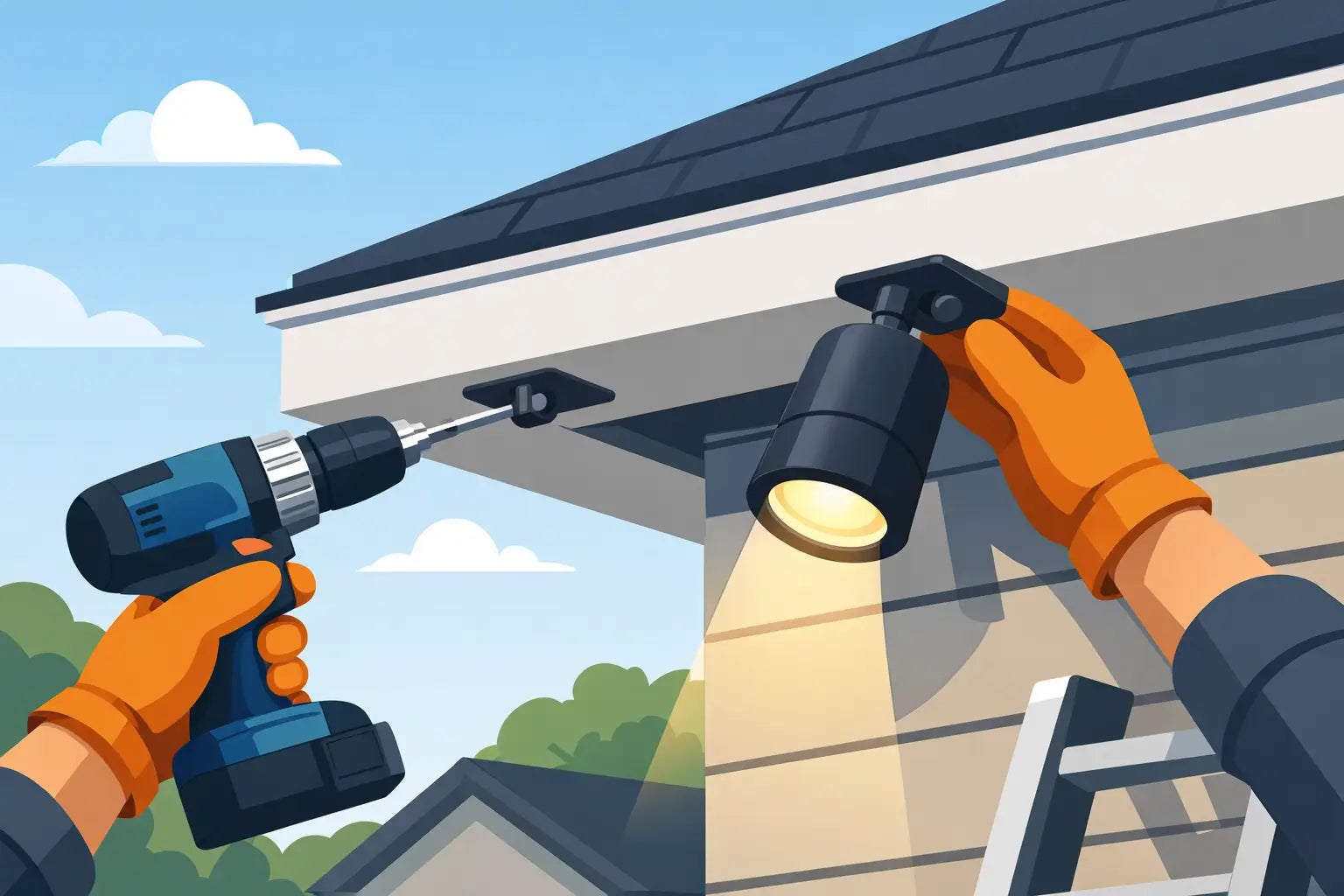
A fascia install can look clean and permanent - or slightly off forever. Most problems start the same way: lights drift out of line, factory clips loosen up, or the beam angle ends up wrong once you step back into the yard. If you are figuring out how to mount lights on fascia, the goal is not just getting them up. It is getting them straight, secure, and able to handle heat, cold, rain, and time.
Fascia is one of the most popular mounting surfaces for permanent outdoor lighting because it gives you a defined edge to follow and a polished finished look from the street. It also comes with constraints. Fascia boards vary in thickness, trim profiles are not always perfectly flat, soffit overhangs can affect light output, and not every stock light mount is built for that geometry. That is why a fascia install works best when you treat it like a fit-and-alignment job, not just a quick adhesive job.
Why fascia mounting works so well
When lights are mounted on fascia, you get a strong visual line that helps the installation look intentional instead of temporary. The board usually runs continuously along the roofline, so spacing stays consistent and the lights can follow the architecture cleanly. For homeowners installing permanent outdoor smart lights, that matters as much in daylight as it does at night.
Fascia can also be easier to work with than mounting under a soffit in tight spaces. You often have better drill access, clearer sight lines for layout, and more freedom to aim the light where you want it. That said, the ideal position depends on your home. A deeper eave, taller trim profile, or uneven edge can change where the light should sit and how the mount should hold it.
How to mount lights on fascia without alignment problems
The biggest mistake is assuming every section of fascia is uniform. It may look straight from the ground, but once you are on a ladder, you will usually find small dips, seams, nail heads, paint buildup, and joints between boards. If you mount each light one by one without a layout reference, those small inconsistencies add up fast.
Start by checking the fascia surface itself. You want a stable, solid mounting area with no rot, soft spots, or peeling sections that could compromise screws or adhesive. If the board is damaged, fix that first. A permanent light install is only as good as the surface holding it.
Next, establish your line before attaching anything. Some homeowners use painter's tape as a temporary visual guide. Others measure down from the top edge of the fascia at every light position. Either method works if it keeps the row consistent. What matters is resisting the urge to eyeball it from six inches away. Fascia installs look right when the full run is consistent from twenty feet away.
Spacing deserves the same level of attention. If your lighting system has a fixed wire spacing between modules, dry-fit a section first and confirm where each light naturally lands across seams, corners, and transitions. You may need to adjust your starting point to avoid awkward placement at the end of a run or near a peak.
Choose mounts built for the light and the surface
This is where a lot of installs either get easier or get frustrating. Generic clips can work in ideal conditions, but fascia mounting is less forgiving than it looks. You need a mount that holds the light body securely, keeps the face aligned, and stays put through seasonal expansion, wind, moisture, and UV exposure.
For permanent smart lighting, product-specific mounts generally give a better result than universal options. They reduce slop in the fit, hold angle more consistently, and make the final run look more uniform. That is especially important on fascia, where every light is visible in a straight line.
If you are working with Govee permanent outdoor lights, purpose-built mounting accessories can solve the two issues homeowners run into most often: poor retention and uneven presentation. A well-designed fascia-compatible mount helps the light sit where it is supposed to sit, instead of twisting slightly or depending too much on adhesive alone.
Fasteners, adhesive, and what actually holds up
There is no single answer here because fascia materials vary. Wood fascia, aluminum-wrapped trim, composite boards, and PVC trim all behave differently. What works on a dry, painted wood board in mild weather may not be the best choice on a slick trim coil in a hot climate.
If you want the most secure long-term install, mechanical fastening is usually the stronger choice. Screws provide a more dependable hold than adhesive by itself, especially for permanent exterior applications. They are less likely to fail from heat cycling, moisture, or surface contamination. The trade-off is that you are making a more committed installation and you need to place each fastener accurately.
Adhesive can still play a role. In some installs, it helps stabilize the mount during placement or adds support where vibration and movement are concerns. But relying on adhesive alone for a permanent fascia installation is where many homeowners run into trouble later. Temperature swings, dirt on the surface, and paint condition all affect bond strength.
If your fascia is wrapped metal or another surface where drilling is not your first choice, test a small section and think long term. The cleanest install on day one is not always the most durable install after a full year outdoors.
Corners, peaks, and tricky sections
Straight runs are the easy part. Corners, gables, and roof peaks are where fascia installs start to separate a polished result from an average one. The spacing may need to shift slightly, the wire path can become more visible, and the mounting angle may need adjustment to keep the lighting effect consistent.
At corners, avoid forcing the light strand to make a sharp bend that puts tension on the wire or twists the light body. Plan a transition that keeps each module seated correctly. On gables and peaks, lay out from the center or from a visible architectural reference point if symmetry matters for the final appearance.
This is also where retrofit-friendly mounting options can save time. If you need to correct position, improve angle, or replace weaker stock hardware after the initial install, a mount designed for that kind of real-world adjustment makes the job much less painful.
Weather, heat, and durability matter more than most people expect
Permanent outdoor lights live through more abuse than homeowners usually account for. Summer heat softens adhesives. Winter cold makes some plastics brittle. Rain finds its way into every weak point. Add ladder vibration during installation and occasional wind movement, and weak mounting hardware gets exposed quickly.
That is why mount quality matters just as much as light quality. A secure fascia installation should keep the light positioned correctly through the seasons, not just during the first few weeks. Materials need to be weather resistant, dimensionally stable, and suited to exterior use. If a mount flexes too much, cracks under stress, or loses grip over time, the install stops looking permanent.
This is one reason many homeowners move beyond the factory mounting parts and choose purpose-built accessories from specialist brands like PrintWorks 3D. Better fit and stronger retention are not cosmetic upgrades. They directly affect how fast the install goes, how clean it looks, and how well it holds up.
A cleaner fascia install comes down to planning
If you want to know how to mount lights on fascia the right way, think in this order: surface, layout, mount fit, fastening method, and final alignment. Most callbacks and do-overs happen when one of those gets skipped.
Do a dry fit before committing the full run. Step back after the first few lights. Check angle in daylight, not just after dark. Make sure the mount actually suits the fascia profile you have, not the one you assumed you had from the ground. A little extra setup saves a lot of time on a ladder later.
And if your goal is a truly permanent look, do not settle for hardware that feels temporary in your hand. The right mount should make the job easier, the line straighter, and the finished result feel like it belongs on the house. That is what turns a lighting project into an upgrade you will still be happy with after the season changes.
Share:
How to Align Govee Light Strings Right
Govee Mount Compatibility Chart Made Simple