

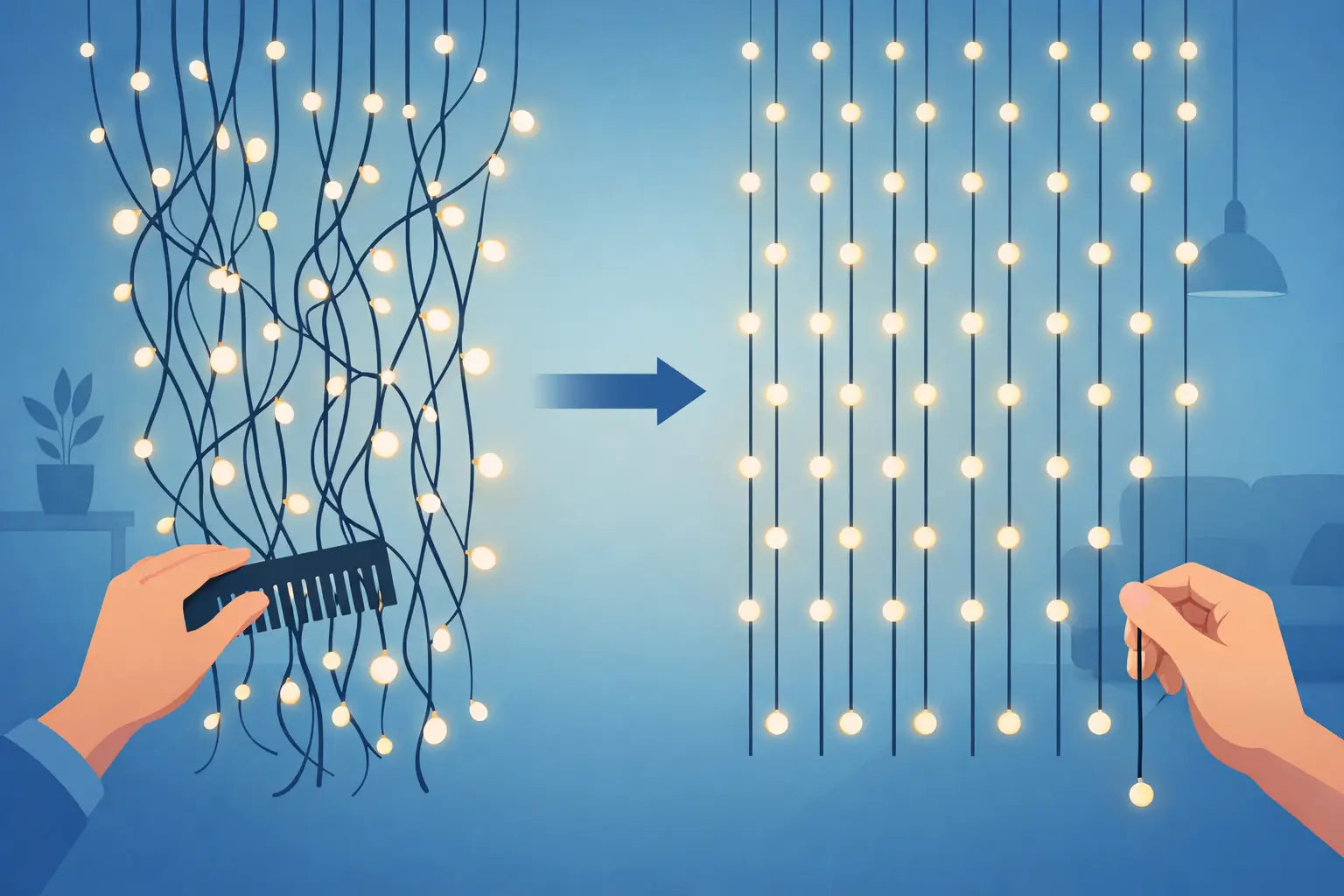
Light curtain strands can look great right out of the box, or they can come out curled, crossed, and determined to hang any way except straight. If you are figuring out how to straighten light curtain strands, the good news is that most of the problem comes from packaging memory, not a defect. That means you can usually fix it with a little patience and the right handling.
The goal is not just to make them look better for one night. A straighter curtain gives you a cleaner pattern, more even spacing, and less strain on the wire where twists and tangles tend to collect. If you are installing them on a window, patio cover, pergola, or outdoor frame, getting the strands straight before final mounting saves a lot of frustration later.
Why light curtain strands won’t hang straight
Most light curtain strands pick up bends because they spend a long time coiled in tight packaging. Thin wire remembers that shape. When you first hang the set, the vertical drops may curl inward, twist around each other, or sit at uneven angles.
Temperature also matters. Cold wire tends to stay stiff and hold its packaged shape longer. Warm wire relaxes more easily. That is why lights installed in a cold garage or on a chilly day often look worse at first than the same set handled indoors.
There is also a difference between a strand that is merely bent and one that is actually tangled. A bend can usually be worked out. A true tangle needs to be separated first. Trying to force a tangled strand straight usually makes the wire kink harder.
How to straighten light curtain strands before installation
The easiest time to fix the strands is before they are fully mounted. Once everything is attached, every correction takes longer and usually involves working overhead.
Start by laying the curtain lights on a clean, flat surface. A floor, large table, or even a driveway works if the area is dry and free of grit. Let the main horizontal line sit straight, then separate each drop so you can see whether you are dealing with simple curl, crossover, or knots.
If the strands are twisted around each other, undo that first with your hands. Work slowly from the top connection point downward. Pulling from the bottom can tighten the twist instead of releasing it.
Next, gently run your fingers down each strand. Do not pinch hard or yank. The idea is to guide the wire into a relaxed position, not to stretch it. If you feel resistance, stop and find where the bend or crossover starts.
For mild curling, sometimes gravity does most of the work. Hold the top line level and let the strands hang freely for a few hours indoors. In many cases, that alone will reduce the worst bends enough for a cleaner install.
Using warmth to relax the wire
If you need faster results, gentle warmth helps. This is often the most effective answer to how to straighten light curtain strands without overhandling them.
A warm room is the safest option. Bring the lights inside, uncoil them, and let them rest at room temperature. If the strands are still stubborn, you can place them in indirect sunlight for a short time. The wire softens slightly, which makes it easier to relax the curl by hand.
The key word is gentle. You do not want high heat. Avoid heat guns, open flames, or anything that can soften insulation unevenly. Even a hair dryer should be used carefully and from a distance, if at all. Too much concentrated heat can damage the wire jacket, affect adhesives on nearby mounting surfaces, or create weak spots that show up later outdoors.
If you use sunlight, keep an eye on the set. Warmth is helpful. Baking the lights on hot pavement is not. A moderate amount of heat paired with light hand-straightening usually gets better results than trying to force cold wire flat.
How to straighten light curtain strands after hanging
Sometimes you do not notice the problem until the lights are already up. That is common, especially once the full weight of the curtain reveals which strands are still twisted.
Start at the top support line and inspect the spacing. If one strand is wrapping around another, detach that section if possible and untwist it near the anchor point. Fixing the top usually corrects the shape below it.
For strands that still curl inward, add time before you add force. Let them hang for a day or two if the installation schedule allows. Many curtain lights settle on their own once gravity has a chance to work.
If they still do not relax, you can lightly guide each strand straight with your hand from top to bottom. On some setups, a small temporary weight clipped at the bottom for a short period can help. The weight should be light, just enough to encourage a straighter drop without stressing the wire or lamp connections. Too much weight is a bad trade. You might get a straighter line, but you also risk stretching the strand or damaging connection points.
Mistakes that make the problem worse
The biggest mistake is rushing. Light curtain strands look simple, but thin wire can kink if it is bent sharply in the wrong direction. Once a hard kink forms, it is much harder to hide.
Another common mistake is pulling from one end to "snap" the strand straight. That rarely works well. It can tighten twists, stress solder points, and create uneven tension across the curtain.
Overheating is another issue. People often assume more heat means faster results, but that can shorten the life of the set. For permanent or seasonal outdoor use, wire condition matters. A strand that looks fine after aggressive heating may become brittle sooner in weather exposure.
It is also worth checking your mounting points. Sometimes the strand is not the real problem. If the top line is sagging, clipped unevenly, or mounted at an angle, the vertical drops can appear crooked even when the wire itself is fine.
Getting a cleaner final look outdoors
Straight strands are only part of the result. The mounting method affects the finished appearance just as much. If the support line shifts in wind or the spacing between anchor points is inconsistent, even a fully relaxed curtain can still look messy.
For outdoor installations, a stable mounting setup makes a big difference in keeping the curtain aligned over time. That matters even more on patios, pergolas, trim lines, and framed openings where uneven drops stand out quickly. Clean spacing at the top helps every strand below it hang more naturally.
If you are building a more permanent smart lighting setup, it helps to think beyond the first install. Accessories designed for specific lighting systems can reduce movement, improve alignment, and make the overall result look more intentional. That is the same reason homeowners upgrading their exterior lighting often move away from one-size-fits-all clips and toward purpose-built mounting hardware from brands like PrintWorks 3D.
When a strand may actually be damaged
Most bent strands can be corrected, but not every problem is cosmetic. If one drop stays sharply kinked, flickers when moved, or has visible damage to the insulation, straightening is no longer the main concern.
At that point, inspect the wire closely. Look for crushed sections, exposed conductors, or loose lamp connections. If the strand was pinched during shipping or installation, forcing it straight may only hide a reliability issue. For outdoor use, especially, damaged insulation is something to take seriously.
If the lights power on inconsistently after handling, stop adjusting and test the set safely according to the manufacturer instructions. A clean-looking install is not worth keeping a compromised strand in service.
A better approach for future storage
If you want straighter strands next season, how you store them matters. Tight wrapping recreates the same memory that caused the problem in the first place.
Instead of twisting the curtain into a compact ball, store it in wide, loose loops. Keep the vertical drops separated as much as possible. A storage reel or flat bin can help, as long as the strands are not crushed under other holiday or outdoor gear.
Try to store the set in a moderate environment. Extreme heat can age materials faster, and extreme cold can make wire stiffer when you unpack it again. Better storage does not guarantee a perfectly straight curtain next time, but it usually cuts setup time and reduces tangles.
Straightening light curtain strands is mostly about patience, gentle handling, and giving the wire a chance to relax before you force it into place. A few extra minutes before or during installation usually pays off with a cleaner, sharper display that looks like it was meant to be there.
Share:
Best Mounts for Govee Gables
Govee Light Curtain Spacers Explained