

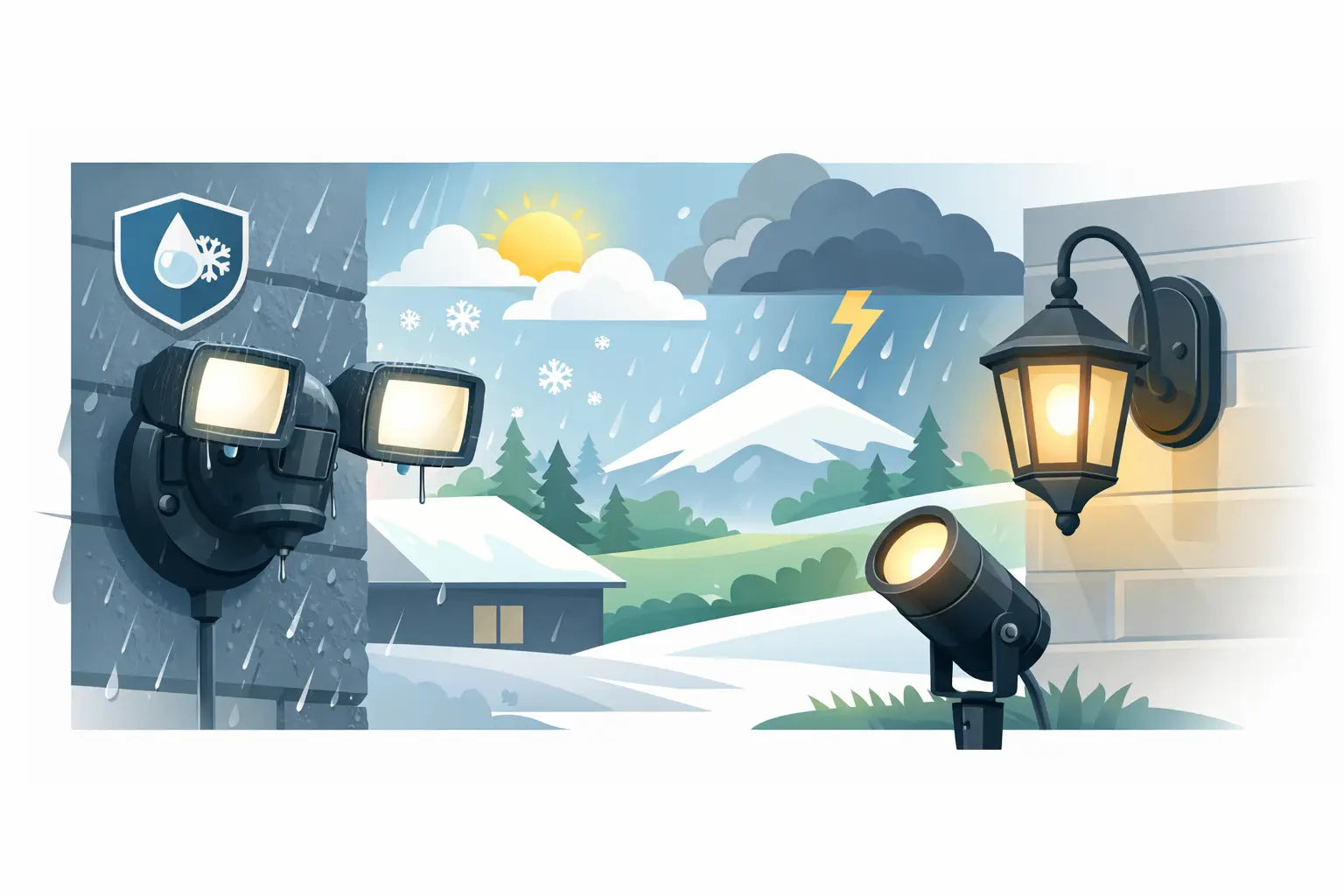
A permanent lighting install usually looks great from the street and frustratingly imperfect up close. Lights drift out of alignment. Factory clips loosen. Adhesive gives up after a season of sun, rain, and temperature swings. That is exactly why weather resistant mounts for outdoor lights matter - not as an accessory, but as the part that determines whether your setup still looks clean six months from now.
If you are mounting smart outdoor lights along rooflines, peaks, soffits, or fascia, the real challenge is not turning the lights on. It is keeping every section secure, evenly spaced, and properly aimed through changing weather. A mount that fits the light correctly and stays stable on the surface does more than hold hardware in place. It protects the look of the install, cuts down on rework, and helps your lighting investment feel permanent.
Why weather resistant mounts for outdoor lights matter
Outdoor lighting lives in a rough environment. Heat can soften weak materials. Cold can make brittle parts crack. Rain works into small gaps, and wind keeps testing every connection point. When a mount is too generic, too thin, or not shaped for the specific light it is holding, those conditions show up fast.
Homeowners often notice the same pattern. The first install goes up quickly, but after a few storms or a hot summer, one section starts to sag. Then another shifts. Soon the straight line you wanted across the roof edge turns into a series of small misalignments that are hard to ignore. The lights may still function, but the finished look is gone.
A weather-resistant mount solves that problem by focusing on long-term hold, not just first-day placement. Good mounts are designed around real exterior conditions and around the actual shape of the lighting system. That combination matters because durability is not only about the material. It is also about how well the mount supports the light, distributes stress, and stays anchored to the structure.
What actually makes a mount weather resistant
Weather resistance is easy to claim and harder to deliver. In practice, it comes down to three things: material behavior outdoors, fit with the light itself, and how the mount interacts with the mounting surface.
Material quality is the first checkpoint. Outdoor mounts need to handle UV exposure, summer heat, winter cold, and moisture without warping or becoming fragile. A part that looks solid on a workbench can behave very differently after months under direct sun near a roof edge. That is why purpose-built materials matter. The right material keeps its shape, holds fasteners or adhesive surfaces reliably, and resists the kind of fatigue that causes failure over time.
Fit is the second checkpoint, and this is where many generic options fall short. If a mount is not engineered for a specific light body, wire path, or spacing requirement, it introduces movement. Even small play becomes a problem outdoors. Wind vibration, expansion and contraction, and repeated weather cycles all work against a loose fit. A snug, model-specific mount reduces those issues before they start.
The third checkpoint is mounting geometry. Outdoor lights are installed on a wide range of surfaces, from flat soffits to angled trim to architectural peaks. A good mount accounts for orientation and presentation, not just attachment. That affects beam direction, visual consistency, and how securely the light sits once installed.
The problem with stock clips and generic options
Stock hardware is often designed to be broadly usable, quick to package, and inexpensive to produce. That does not always translate into a better install on a real home. Many homeowners find that included clips work well enough in ideal conditions but become the weak link when the install gets more demanding.
The issue is not that every factory clip fails. It is that stock hardware is usually built for average scenarios, while permanent outdoor lighting rarely feels average when you are on a ladder, working around corners, trim changes, and uneven surfaces. If the clip has limited holding strength or a loose fit, you spend more time adjusting lights, doubling back, and trying to keep lines straight.
Generic mounts have a similar trade-off. They may fit several products loosely, but that versatility often comes at the cost of stability and appearance. For homeowners who want a polished look across the front of the house, a mount that is merely compatible is often not good enough.
Choosing weather resistant mounts for outdoor lights
The best mount depends on the light model, the install location, and how finished you want the result to look. For rooflines and soffits, consistency matters most. You want mounts that keep spacing uniform and maintain the intended angle so the lighting effect reads cleanly from the ground.
For peaks, gables, and other architectural transitions, the challenge changes. Standard hardware can struggle with these areas because the shape of the home introduces odd angles and visual breaks. A mount designed for those transitions helps preserve alignment instead of forcing you to improvise. That usually means a cleaner look and less trial and error during installation.
Controller and power locations deserve the same attention. A great light install can still look unfinished if the supporting components are left loosely placed or awkwardly attached. Dedicated power and controller mounts help organize the system, protect components, and give the whole project a more intentional finish.
This is where product-specific design makes a real difference. PrintWorks 3D focuses on purpose-built mounts for Govee lighting systems because fit problems are rarely solved by one-size-fits-all hardware. When the mount is designed around the product you actually own, installation gets easier and the result tends to look better.
Installation performance matters as much as durability
A mount can be strong and still be frustrating to use. That matters because most homeowners are installing outdoors, often on ladders, and usually trying to finish the job in a limited weather window. Hardware that is awkward to position or inconsistent from piece to piece slows everything down.
Good installation performance means the mount is easy to place, repeatable across long runs, and dependable once secured. You should not need to fight each piece to get a consistent result. The right mount reduces small errors that become obvious across a full roofline.
This is also where retrofit-friendly design helps. Some homeowners are replacing failed stock clips on an existing setup, while others are planning a fresh installation from the start. A mount that works well in either situation gives you more flexibility. You can improve a current installation without rebuilding everything from scratch.
Clean aesthetics are part of the job
Outdoor lighting is functional, but it is also visual. People notice when lights are uneven, tilted, or loosely placed. The mount plays a direct role in that final appearance.
A well-designed mount keeps each light positioned the way it was meant to be seen. That consistency matters whether your lights are on every evening, used for holiday patterns, or only turned on for special occasions. If the hardware keeps the line crisp and the presentation uniform, the whole home looks more finished.
There is a practical benefit here too. When the install looks clean, you are less likely to keep adjusting it. That saves time and avoids extra wear from repeated handling.
When cheaper hardware costs more
It is tempting to save money on mounts, especially after investing in smart lighting. But outdoor hardware is one of those areas where cheap can become expensive fast. If mounts fail early, you are not just replacing plastic. You are spending time on a ladder again, dealing with misaligned sections, and possibly risking damage to the lights or the mounting surface.
Higher-quality mounts usually pay for themselves through fewer corrections, a better-looking install, and less maintenance. That does not mean the most expensive option is always the right one. It means the value comes from fit, outdoor durability, and installation performance, not from the lowest upfront price.
For homeowners planning a permanent setup, that trade-off is usually clear. The mount is not the place to compromise if you want the lighting to stay secure and look intentional year-round.
A better permanent-lighting setup starts with the mount
If your goal is a clean, secure exterior lighting install that holds up through real weather, the mount deserves the same attention as the lights themselves. Weather resistant mounts for outdoor lights are what turn a good-looking first install into a setup that still performs after heat, wind, rain, and seasonal change.
The right choice comes down to specifics: the light model, the mounting surface, the angles of your home, and how permanent you want the result to feel. When those details are built into the hardware from the start, installation gets easier and the finished look holds its line. That is usually the difference between lighting that looks added on and lighting that looks like it belongs there.
Share:
Govee Permanent Lights Mount Replacement
How to Install Outdoor LED Lights on Soffit